
The Challenge
Washington is one of only seven states to require a supermajority vote to pass a bond election (60% approval). Washington’s 60% supermajority requirement, combined with declining public confidence in schools and heightened compliance risk makes it increasingly difficult for districts to build enough voter trust to pass construction bonds.
Research
National Public School Research
- A September 2025 national Gallup poll showed that the low sentiment of public schools we were seeing in Washington State was true across the country as well.
Statewide Landscape Research
- Several team members attended statewide election conferences hosted by municipal finance authorities Piper Sandler and D.A. Davidson in September to identify statewide turnout patterns and messaging headwinds.
- Our team analyzed and discussed PDC findings after each election, which informed our compliance checklist and election best practices.
- Since 2020, our weekly ESD 112 Communications Consortium meetings have brought communications leaders from across the state together to share best practices for school funding measures. This collective wisdom validates sentiment data and shapes successful outreach strategies statewide.
District-Specific Research
For each client partner we:
Reviewed existing web pages
Conducted focus group interviews with school leadership
Combed through Facilities Advisory Committee pages and meeting minutes
Reviewed recent survey results and other quantitative or qualitative data
Planning
After completing our statewide and national landscape scan, compliance review, and district-level discovery process, we moved into planning for the February 2026 election cycle.
Goal
School districts feel confident in their decision to partner with ESD 112 communications and know that the team relies on tailored approaches, current information and deep knowledge about election communications best practices amid a challenging school funding measure landscape.
Measurable Objectives
-
100% Passage Rate: By certification, pass 3/3 bonds with ≥ 60% approval (target ≥ 65%), exceeding the February 2025 statewide bond passage rate of 45%.
-
100% PDC Compliance: Receive 0 PDC findings for our partners by the time February 2026 election results are certified.
Strategies & Tactics
Our overall strategy for meeting our measurable objectives for bond measures, while also supporting a record number of levy measures and a heavy non-election communications workload, was to plan carefully and think more strategically about our staffing.
1. Organize & Plan Ahead
- Create a shared collaboration space for each district partner and organize all elections-related documents and materials there for easy access between our internal team and district partners.
- Internally track our partner outreach initiatives in a spreadsheet with clear roles and responsibilities assigned to each team member. Share resources via an internal resource hub.
2. Educate & Cross-Train
-
Ensure that our district partners are aware of and align with PDC guidance, as well as election communications best practices.
-
Train new and less experienced team members on election communications.
3. Prioritize High-Stakes Work
- Prioritize our work for the February election initiatives, particularly bond campaigns, above other, less urgent projects.
Implementation
We began by meeting individually with each district partner to gather basic information about the initiatives, to better understand the community’s strengths and challenges, and where there might be opportunities and threats. For each district, we outlined key messaging information that would later be used for district materials. This messaging was reviewed for accuracy, clarity, and tone by the district’s communications staff (if they had communication staff), the superintendent, and the chief financial officer. From there, we created presentations, web and social media graphics, videos, and print materials, as desired by the district.
We pride ourselves on tailoring our services to the needs of our district partners, so the implementation of each initiative followed our districts’ needs, based on their staff capacity and budget combined with our strategic communications recommendations. In brief, this was our approach for each bond partner:
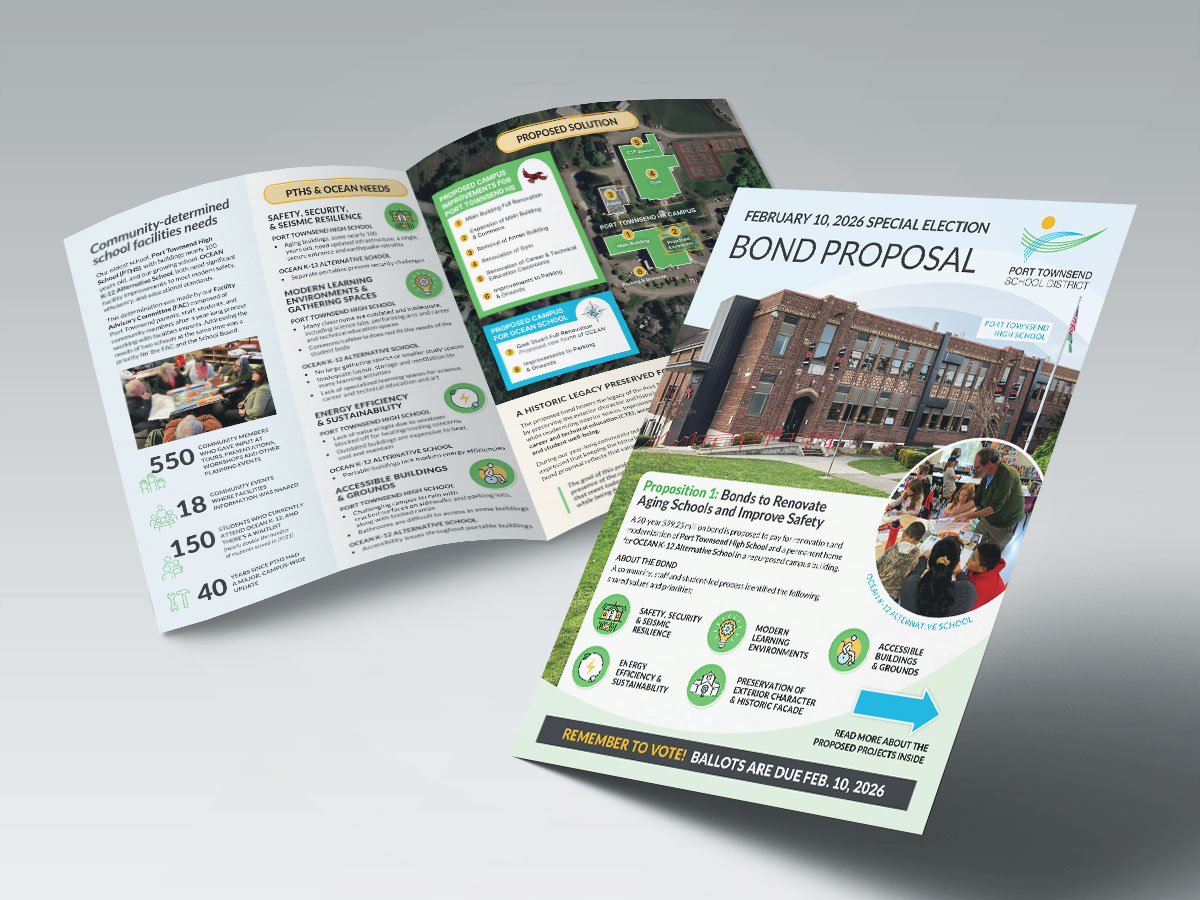

Port Townsend School District has a community supportive of schools and aware of the need for more modern buildings that meet seismic resilience standards. Their high school has brick buildings that are nearly 100 years old. These historic buildings look beautiful on the outside, but they are very difficult for the district to maintain and do not meet modern learning needs. In addition, the district has a popular alternative school that is completely housed in portable classrooms. Our messaging approach for Port Townsend was:
- to ensure that the community is aware of the unique programming of each school and their facilities needs; and
- to reassure community members that historic features of the high school would be preserved, while being fiscally responsible and creating modern learning spaces.
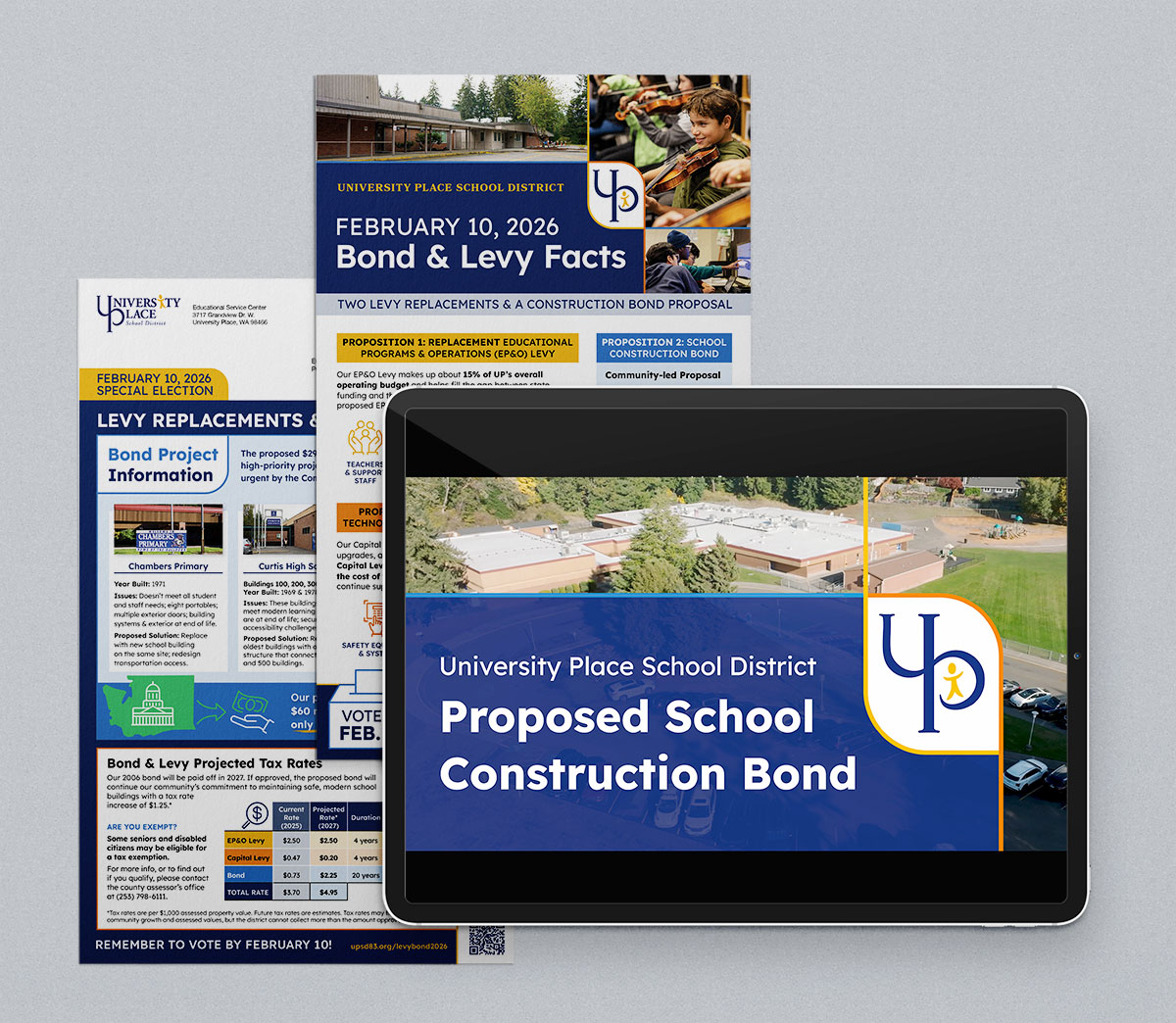

University Place School District has a very supportive community, and residents move to the district for its schools. The challenge was that the district was new to us and starting its work late in the process. UPSD had three measures on the February ballot: a replacement operations levy, the bond, and a replacement capital levy, making the ask among the highest in the state. Our approach for UPSD was:
- to ensure that the community was aware of all three ballot measures using a color-coded design approach;
- to build awareness of the need for each of the three measures through video, signage, social media posts, and print publications; and
- to engage the community using events and historic “throwback” photos on social media.
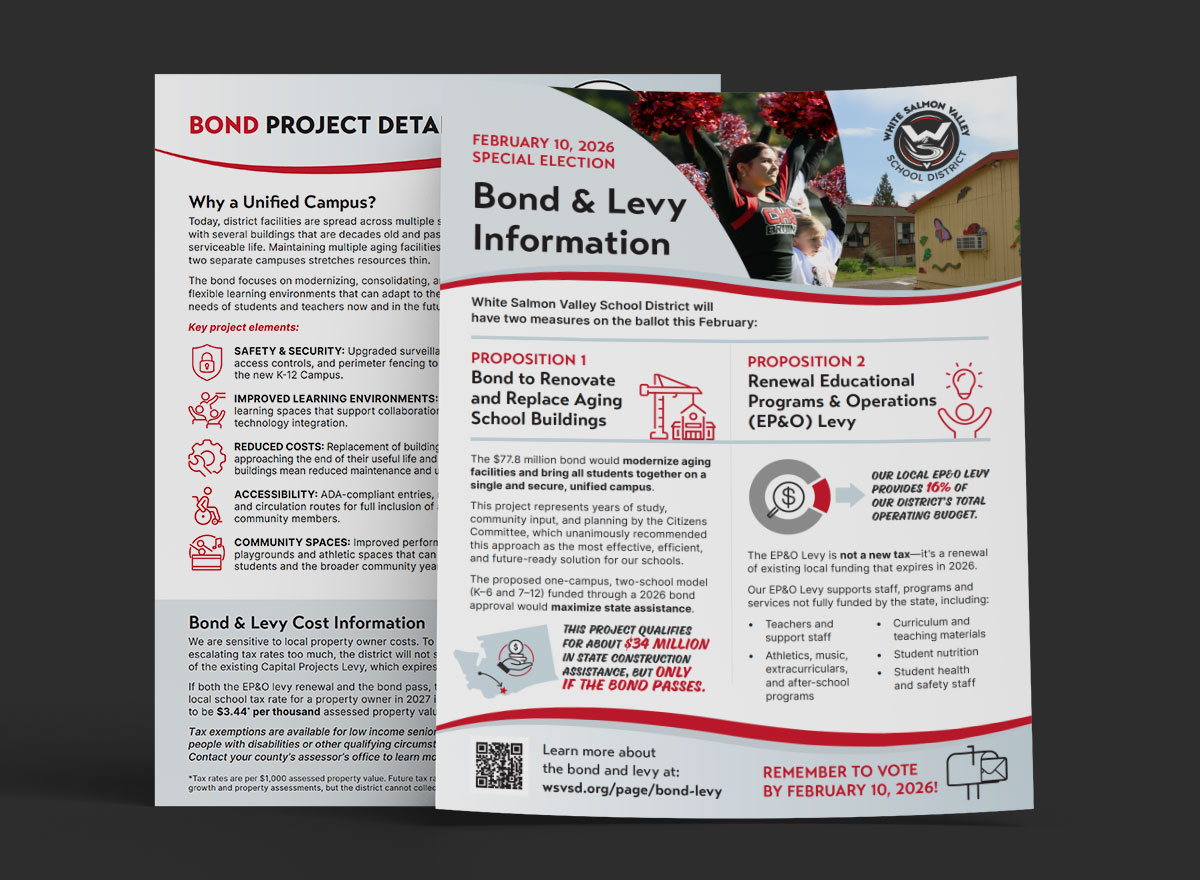
White Salmon Valley School District is a small district located in a rural area, and enrollment is on the decline. The district’s bond proposal was to consolidate its schools onto one unified K-12 campus, closing the current elementary school, which had outlived its useful life. In our approach for WSVSD we had to:
- explain why the consolidated campus approach was worthwhile, despite the increase in taxes and declining enrollment;
- help the community to understand that, while the elementary school building looked OK on the outside, it was extremely difficult and expensive to maintain; and
- avoid making any promises about what would happen to the old elementary school, which would be determined as a separate community process.
Results
We exceeded expectations for both objectives: Our partners received zero PDC findings (and zero complaints), and our passage rate for the bond measures was 100%—all three bonds passed with over 65% voter approvals. In addition to the successful passage of the three bond measures, 26/27 partner levy measures passed, for a total passage rate of 97% for our 22 district partners. This exceeds the overall passage rate of 92% of all measures statewide.
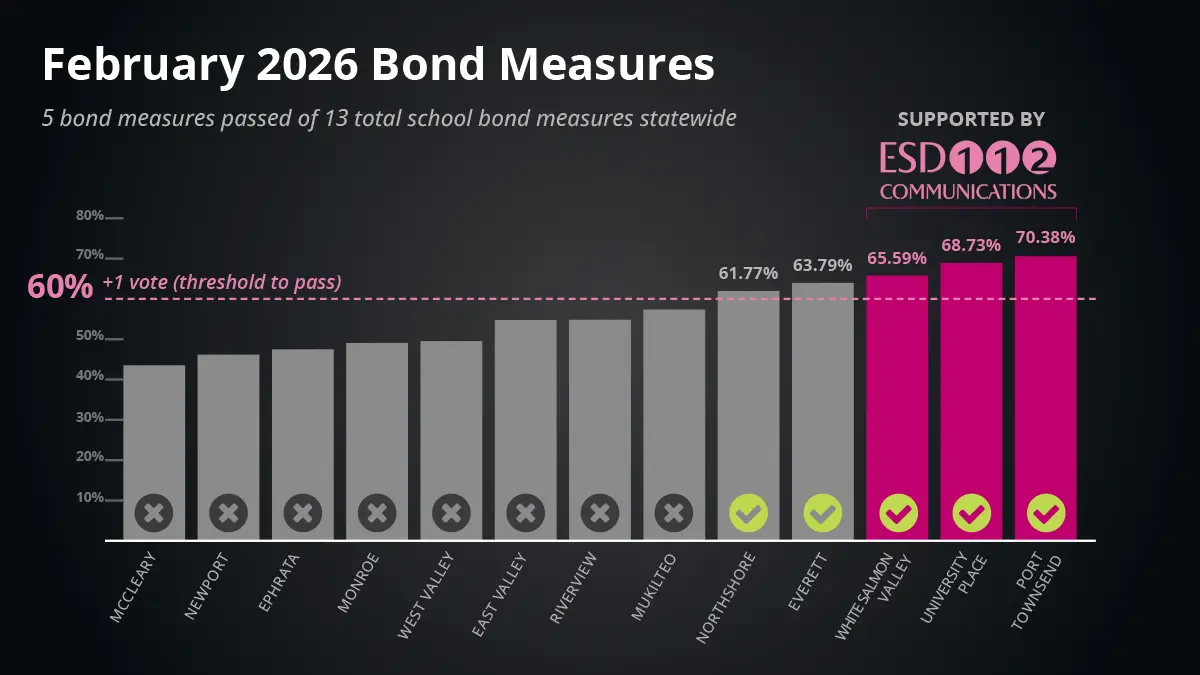
The three bond measures we supported were the top three voter-supported bonds in the entire state
Conclusion
The meticulous planning and staff training we engaged in leading up to election crunch time ensured that all election-related requests for our district partners were fulfilled on time and met our strict quality and compliance standards. Our team had never before supported three school bond measures in one election, on top of a record number of levy measures, but we went into election day knowing that we had done our very best for our district partners.
The White Salmon Valley superintendent, Rich Polkinghorn said it best on election day: “To borrow a sports saying, ‘We left it all on the field.’ It’s up to the voters now.”
From the earliest planning conversations to the final outreach push, ESD 112’s Communications Team brought the kind of expertise and insight that makes a real difference. Their strategic counsel, high-quality materials, and reliable social media support strengthened our work at
every stage.
Award-Winning!
The National School Public Relations Association (NSPRA) presented this work with a 2026 Golden Achievement Award. NSPRA’s Golden Achievement Awards program recognizes outstanding, strategic work in all aspects of school public relations, communication, marketing and engagement.
We couldn’t do it without our district partners
This incredible honor is one shared with our district partners. Without your trust in us, collaboration, strategic thought, and information-sharing this recognition would not be possible. This is OUR honor that we share together. Thank you to those who partnered with us for this specific body of work: Port Townsend School District, University Place School District, and White Salmon School District.