

How did you find your way into school communications?
I kind of found my way into education early in my career. I started at Heritage University and quickly realized that while I loved being part of education, working directly with students wasn’t where I was meant to be.
As a first-generation college student, I knew firsthand how life-changing education could be. Being surrounded by that environment every day gave me a deeper appreciation for the impact schools and educators have on people’s lives. I realized I wanted to contribute to that mission in the way I do best: through communications.
When I transitioned into school communications, it turned out to be the perfect fit. I get to combine my love of strategic communications with my belief in public education by helping districts tell their stories, build trust with their communities and make sure families have the information they need.
Looking back, I didn’t intentionally set out to build a career in education, but I’m really glad my career found its way here.
What drew you to ESD 112?
Before joining ESD 112, I had the opportunity to work with the communications team through a previous school district. From the beginning, I was impressed by the breadth of talent across the team. Everyone brought different strengths to the table, yet they consistently produced an incredible amount of high-quality work.
What stood out even more was the way they worked with us. It never felt like they were an outside organization providing a service. They felt like an extension of our own team. Everyone was collaborative, dependable and genuinely invested in helping us succeed.
I remember thinking, “If I ever make a career change, I want to work with a team like this.” When the opportunity to join ESD 112 came along, it felt like the right fit.
What kind of communications work do you enjoy most?
Give me a complicated issue, a lot of moving pieces and a clear goal, and I’m happy.
I especially enjoy projects where communications can help solve a larger problem, not just create a product. That might be developing a strategy around a bond or levy, helping a district navigate a challenging issue, building a campaign or taking something complicated and figuring out how to make it clear and actionable for the people who need to understand it.
I love asking questions, anticipating what people will need, identifying potential gaps and putting all the pieces together into a plan. The finished product is always rewarding, but figuring out the strategy that gets us there is usually the best part.

Ashley lives in Yakima and serves school district partners in the central Washington region.
What makes that work fulfilling for you?
The most fulfilling part is helping make something difficult feel manageable.
One of my favorite moments is at the end of a meeting when I can physically see someone’s shoulders drop and hear that sigh of relief because there’s a plan and they know they don’t have to figure it all out alone.
Interestingly, some of the most fulfilling parts of the job are also the most challenging. Crisis and issue communications can involve circumstances completely outside of a district’s control, whether it’s something affecting one community or a larger challenge facing districts across the state.
Those situations rarely have a perfect answer, but that’s also the kind of challenge I welcome. I enjoy taking something that feels overwhelming, finding the pieces we can influence and building a thoughtful communications strategy from there.

Ashley and her husband, Cody, with their dogs.
What’s one communications principle you come back to again and again?
Pay attention to the little things.
Good communication isn’t always a perfectly written message or a big campaign. Sometimes it’s remembering to follow up, anticipating the question someone is going to ask next, making information easier to find or taking a few extra minutes to make sure someone feels heard and supported.
Those details may not be the most exciting part of communications, but they build trust. And trust is ultimately what makes the rest of our work effective.
What inspires you?
Possibility.
I’ve always been a big believer that if there’s a will, there’s a way. I love looking at an idea or a challenge and thinking about what could be possible, then figuring out how to make it happen.
I’m not easily discouraged by something being complicated or by there not being an obvious path forward. If anything, that makes me want to dig in a little more. I like asking questions, finding the pieces we can work with and coming up with a way to get where we want to go.
There’s something really rewarding about taking something that starts as a “What if?” and helping turn it into a “We did it.”

At work, Ashley is as persistent and hard-working as her two border collies, Duke and Blue.
So what happens when someone tells you, “We’ve always done it this way”?
I immediately have approximately 17 follow-up questions.
I love a good process, but I love an effective process even more. If something works, great! Let’s keep it. But if we’re doing something simply because we’ve always done it that way, there’s a pretty good chance I’m going to start asking why, who it’s working for and whether there’s a better way to get where we’re trying to go.
I promise the questions are coming from a good place.
Favorite industry trend right now? Least favorite?
AI and AI.
I love what AI can do to make communications work more efficient, help us brainstorm, organize ideas, work through a problem or get past the dreaded blank page. Used well, it gives us more time to focus on the strategic and human parts of our work.
On the other hand, AI has made it very easy to produce more communication without necessarily producing better communication. Everything can start to look and sound the same, which makes it even harder for our communities to know what information is credible and what they can trust.
If our communications lose the human voice behind them, or we publish something without stopping to ask, “Does this actually sound like us, and will our community know it came from us?” we’ve missed the point.
AI should help us communicate more effectively, not make us indistinguishable from everyone else.
Speaking of being human, tell us about life outside of work.
My husband, Cody—my college sweetheart (GO COUGS!)—and I live on a small farm in the Yakima Valley. We love to travel together, spend time outdoors and make it to WSU football games whenever we can. But for as much as we enjoy getting out and exploring, we’re genuinely homebodies at heart. We’ve created a life at home that we really enjoy, so some of our favorite weekends are the ones where we don’t have anywhere we need to be.
Of course, part of what keeps us close to home is our pretty sizable animal crew. We have two border collies, Duke and Blue, who are involved in just about everything we do. Then there are our three cats—Marley, Moose and Dixie—and a pretty large flock of chickens.
A lot of my time at home is also spent on horseback. I have two horses, Bell and Lance. Bell has been with me for more than 23 years, and Lance is the newest addition—a recently retired racehorse who, despite his former career, is a big, gentle giant.
Between the farm, animals, projects and everything else we enjoy at home, there’s usually plenty to keep us busy, which is exactly how we like it.
With all of that going on, how do you unplug and decompress?
You’re going to laugh at me, but my favorite way to decompress is some good, old-fashioned back-breaking labor.
I’m happiest puttering around outside, working on projects—and, as my husband likes to point out, creating new ones. I have a large vegetable garden and genuinely love every part of the process: building compost, starting plants from seed, planting, weeding—okay, maybe not always the weeding—harvesting and preserving as much as I can for the year.
Horses have also been part of my life for as long as I can remember. I’ve been riding since I was barely old enough to walk, and I can confirm that the “crazy horse girl” phase is not actually a phase. You just grow up, get your own property and realize no one can stop you from adding another horse to the barn.
I also love to cook, especially when I can build a meal around something I grew in the garden.
When I finish working my day job, I pretty much head straight into my every-other-time-of-day job. The nice thing about farm work is you never have to wonder what to do next. I wouldn’t want it any other way.
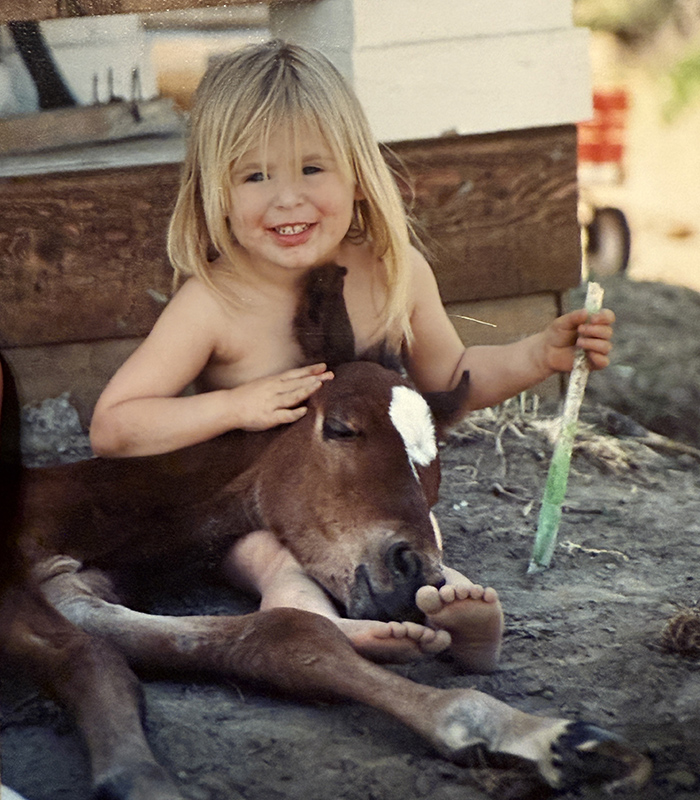
“Crazy Horse Girl” as a little girl (in the dirt, as usual)
